
Why More Contractors and Developers Are Replacing Traditional Doors with WPC Door Systems
For many project managers, the biggest challenge isn't selecting a door—it's avoiding the costly problems that appear years after installation.
Warping. Swelling. Peeling finishes. Mold growth. Frame deformation. These are some of the most common issues reported in hotels, apartments, hospitals, schools, and commercial buildings located in humid environments.
What often starts as a small material failure can quickly turn into a major maintenance expense across hundreds or even thousands of door openings.
This is exactly why an increasing number of architects, developers, distributors, and construction companies are switching to WPC doors with frames. Designed specifically to withstand moisture, temperature fluctuations, and demanding commercial use, WPC door systems provide a long-term solution where traditional wood products frequently struggle.
In modern construction projects, durability is no longer optional. Building owners are increasingly evaluating products based on lifecycle performance rather than initial purchase price alone.
Traditional timber doors may offer a natural appearance, but their performance in high-humidity conditions remains a concern. Continuous exposure to moisture can cause wood fibers to expand, leading to deformation, cracking, and structural instability.
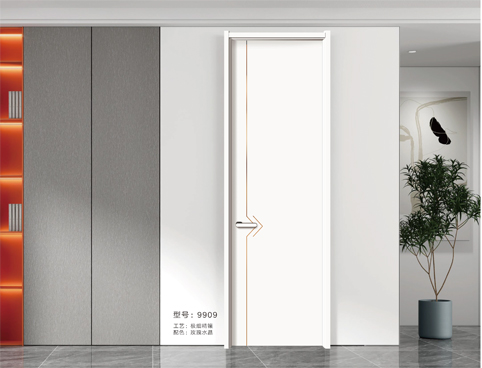
Even certain engineered wood products eventually suffer from moisture-related deterioration.
WPC (Wood Plastic Composite) technology was developed specifically to overcome these limitations.
By combining wood fibers with advanced thermoplastic materials, WPC doors deliver the appearance of traditional wood while providing significantly greater resistance to environmental challenges.
For distributors and project buyers, this means fewer warranty claims, lower maintenance costs, and improved customer satisfaction throughout the building's service life.
The superior performance of a WPC door begins with its material composition.
Unlike conventional wood products, WPC is manufactured using a carefully engineered blend of wood powder and thermoplastic polymers such as PVC or PE. During production, these materials are processed under high temperature and pressure to form a dense, stable composite structure.
The key advantage lies in the way polymer molecules completely surround and protect the wood fibers.
This protective barrier prevents moisture from penetrating the material and eliminates the root causes of common door failures, including:
-
Water absorption
-
Fiber swelling
-
Rot and decay
-
Structural weakening
-
Surface deformation
Because water cannot easily penetrate the internal structure, WPC doors maintain their shape and performance even in environments where traditional doors would deteriorate.
When evaluating door materials for commercial projects, moisture absorption rates are one of the most important technical indicators.
Premium WPC doors typically achieve water absorption rates below 1%, significantly outperforming solid wood and MDF alternatives.
For project procurement teams, this translates directly into greater reliability and lower maintenance requirements over the life of the building.
When specifying doors for bathrooms, coastal properties, hospitality projects, healthcare facilities, or public buildings, material stability becomes a critical consideration.
Traditional Solid Wood Doors
Advantages:
-
Natural appearance
-
Premium aesthetic value
Limitations:
-
High moisture absorption
-
Risk of swelling and warping
-
Susceptible to mold and insect damage
-
Higher maintenance requirements
MDF and Engineered Wood Doors
Advantages:
-
Competitive initial cost
-
Consistent appearance
Limitations:
-
Sensitive to prolonged moisture exposure
-
Edge swelling in humid conditions
-
Reduced durability in wet environments
WPC Doors with Frames
Advantages:
-
Exceptional water resistance
-
Excellent dimensional stability
-
Resistant to mold, mildew, and termites
-
Minimal maintenance requirements
-
Long service life
For large-scale projects, these benefits significantly reduce long-term ownership costs while improving operational efficiency.
Not all WPC doors are manufactured to the same standard.
The long-term performance of a WPC door system depends heavily on production quality and material consistency.
Precision Extrusion Technology
High-quality WPC manufacturers maintain strict control over:
-
Material formulation
-
Density distribution
-
Extrusion temperature
- Internal structure consistency
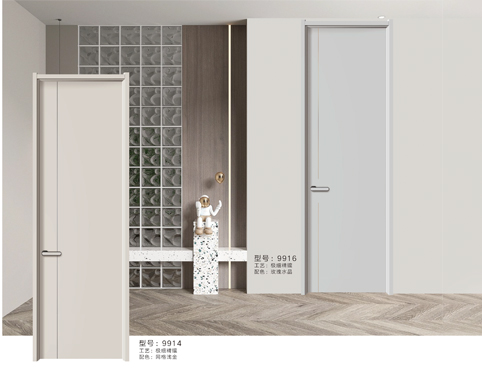
Uniform density throughout the door slab and frame minimizes internal stress points and improves overall structural stability.
Every construction material expands and contracts to some degree.
However, WPC offers a major advantage compared to pure plastic products due to its balanced composite structure.
Its relatively low and stable coefficient of thermal expansion helps prevent:
-
Door warping
-
Frame distortion
-
Joint separation
-
Operational difficulties
This stability is particularly valuable in regions where temperatures fluctuate significantly throughout the year.
TAG: wpc profiles wpc doors wpc door frame